
Go-to-market has become a fancier word for demand gen
What you'll get
A way to balance short-term pipeline with the demand and recognition needed to carry next year's growth.
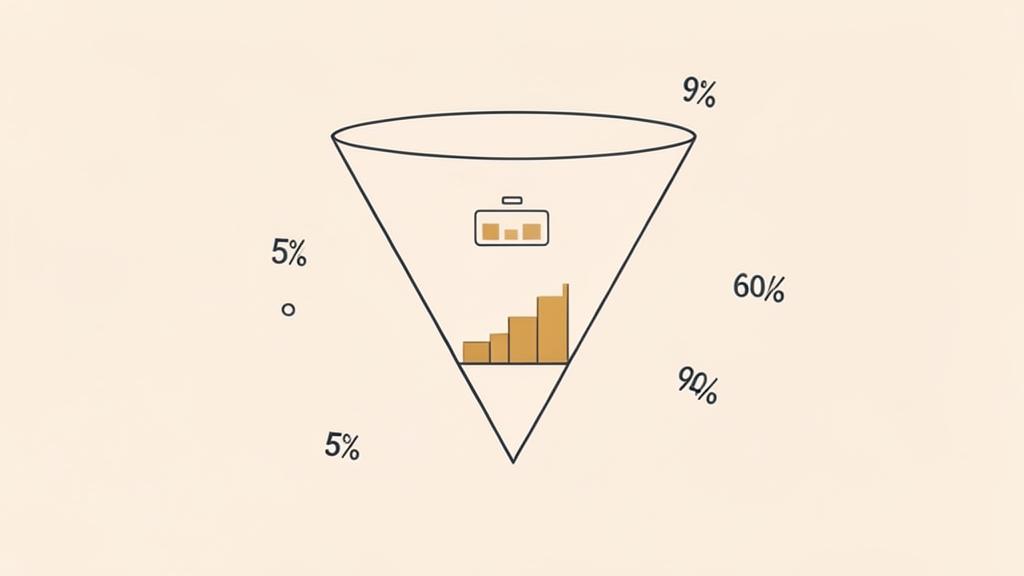
Talk go-to-market with any B2B SaaS founder and you get the same answer. Pipeline. MQLs. CAC. Attribution. In practice, GTM means one thing: more deals this quarter. A fine word, a narrow ambition.
And that's where it falls apart, because the problem is mathematical.
The 95 per cent your dashboard doesn't see
Professor John Dawes at the Ehrenberg-Bass Institute has put a number on something most sales leaders already sense in their gut. At any given moment, only around 5 per cent of your potential buyers are actually in the market. The other 95 per cent aren't thinking about switching systems right now. They have a solution that's good enough, a contract that's still running, more urgent fires to put out.
The maths behind it is banal. A typical B2B contract turns over roughly every five years. That puts 20 per cent of the market in motion over a year, and around 5 per cent in any given quarter. LinkedIn's B2B Institute picked up the insight and gave it a name of its own: the 95:5 rule. The Byron Sharp camp calls it the new 60:40.
Yet we build the entire GTM machine for that five per cent. Paid search, retargeting, outbound sequences of three emails and a call, all aimed at whoever happens to be evaluating right now. We compete for the same small pool as every rival, which drives up the price per lead and means every deal gets decided on price. Then we wonder why CAC only climbs.
Impatience is the symptom itself
If you want to see GTM thinking in its natural habitat, look at how impatient we are. In a survey by LinkedIn's B2B Institute, around 95 per cent of B2B marketers expected significant sales impact within two weeks of a campaign.
Two weeks. For a product with an eighteen-month sales cycle.
That reveals a quiet belief that ads work through persuasion. That the right message at the right moment nudges someone down a funnel and closes the deal. Dawes's research points in exactly the opposite direction. Marketing works mostly by increasing the probability that your name pops into someone's head the day the buyer actually enters the market. Often months or years later.
Why the 95 per cent get zero budget
No one has decided to ignore the large group. It disappears for a much duller reason: it doesn't show up in the report.
Last-click rewards the final click before purchase. A memory you planted with a CFO fourteen months ago, one that got her to keep your company in her mental shortlist, gets zero credit when she eventually googles and clicks your ad. The channel that did the groundwork looks unprofitable. The channel that harvested looks brilliant. So the money keeps moving to where the harvesting happens, year after year, until the brand budget is zero and all growth is borrowed from the future.
Binet and Field documented this drift in The Long and the Short of It for the IPA, built on roughly a thousand cases with proven ROI. Their conclusion became the industry's most cited benchmark: roughly 60 per cent of budget on long-term brand, 40 per cent on short-term activation. For B2B they later adjusted the figure to 46/54, slightly more towards activation because cycles are longer and more people sit round the table.
Do you know where most performance-driven SaaS teams actually sit? More like 20/80. In the wrong direction.
Brand isn't the opposite of GTM. Brand is GTM.
This is the whole point, and it tends to be misunderstood as an argument against measurability. It isn't.
Activation and brand do different jobs on different timescales. Activation captures demand that already exists. The effect is fleeting and resets with every campaign, you start again from the floor every time. Brand builds memory structures that stay and accumulate. Every exposure reinforces the last. One gives you a line that flattens out, the other gives you compound interest.
So when we pit "brand" against "go-to-market" as if it were luxury versus necessity, we've missed what go-to-market even means. For the 5 per cent who are in the market now, your GTM is a landing page and a salesperson. For the 95 per cent who become your pipeline next year, your GTM is what you do so they recognise the name when the day comes.
A real go-to-market takes care of both. The one we sketch out in most boardrooms only takes care of the small half, calls it the whole job, and then wonders why growth is so expensive.
Next time someone says "we need to sharpen our GTM", ask which percentage they mean. The answer tells you everything about whether they're building a company or just a good quarter.
Sources
- 01The 95:5 rule — LinkedIn B2B InstituteLinkedIn B2B Institute
- 02
More to read