
I've stopped writing. With my hands.
What you'll get
A way to judge when dictation speeds up thought — and when the friction of writing actually makes it better.
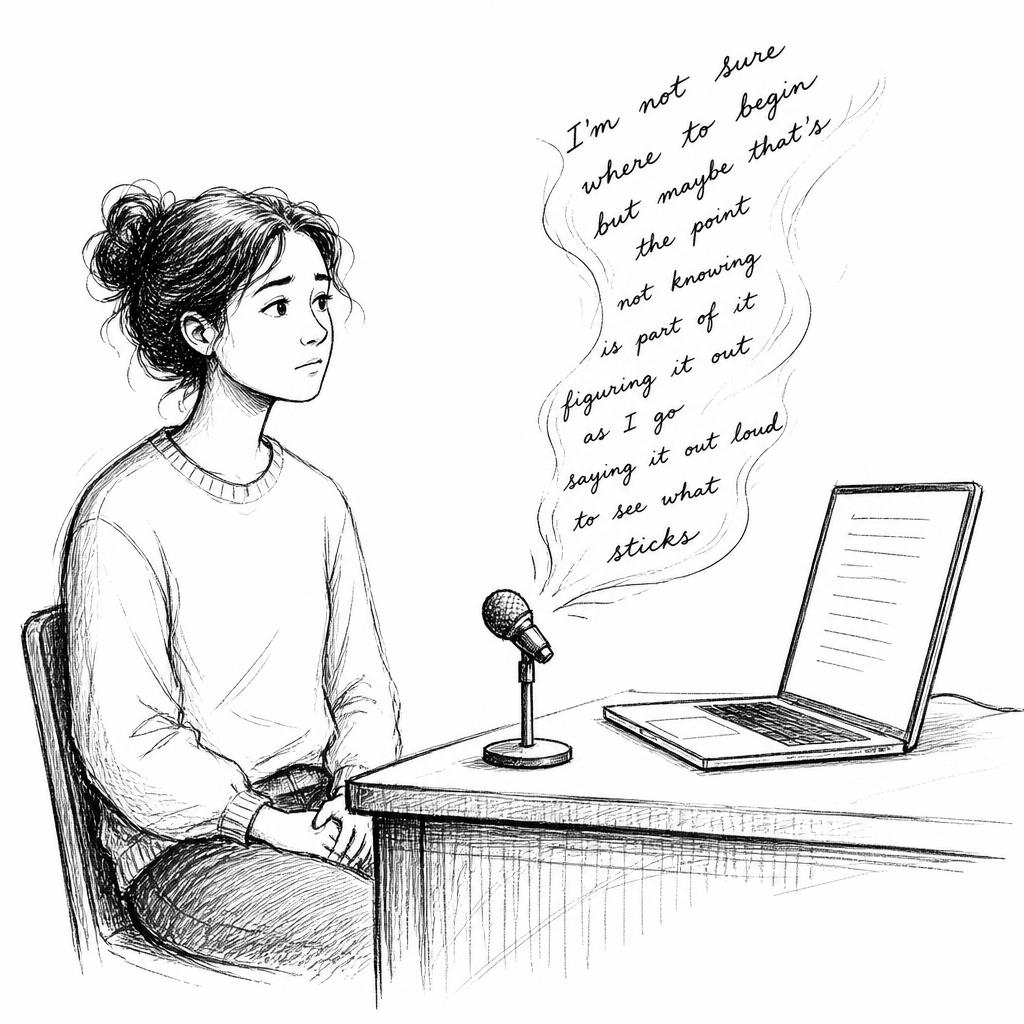
I wrote this without touching the keyboard. Only noticed halfway through. My hands sat still in my lap, I spoke straight out into the room, and the words appeared on screen faster than I could think them through.
At first it felt like magic. Then I read the text back. Something was off. The thoughts were there, but they weren't finished. They were spoken, not thought through.
The tool is called Wispr Flow
The tool is called Wispr Flow. You talk, it types. No lag, no fighting with autocorrect, it even understands my Swenglish. It's the best dictation tool I've tried, and I've tried a few.
The problem isn't the tool. The problem is what happens to the thinking.
Friction is the shape of thought
When I write on a keyboard there's resistance. I have time to change my mind mid-sentence, delete, start over. It's in that friction that the thought takes shape. Writing isn't putting down something I've already finished thinking. Writing is the thinking itself.
There's research pointing in the same direction, even if it's messier than the headlines suggested. In 2014, Pam Mueller and Daniel Oppenheimer published a study with the hard-to-beat title "The Pen Is Mightier Than the Keyboard". Students who took notes by hand understood the material better than those who typed on a laptop. Not because the pen is magic, but because it's slow. If you write by hand you can't keep up word for word. You're forced to summarise, rephrase, decide what the point actually is. If you type on a keyboard you can transcribe verbatim, without really taking it in.
The study has faced pushback since. Later attempts to replicate it weren't as clear-cut, and the big conclusion that keyboards make you dumber doesn't hold up. But the mechanism feels right. The less resistance, the less processing. And dictation is the most frictionless input there is. I never slow down enough to rephrase something. I just say it, and it's already written.
So I built my own
So instead of stopping, I did the only reasonable thing. I built my own.
It's called Viska. Same basic idea as Wispr Flow, just mine. I wanted to understand what I was giving away, and you understand a tool better once you've built it yourself. Partly I built it because I'd rather build than consume. Mostly because I wanted to see if I could.
The funny thing is that to build the tool that lets me avoid writing, I had to write more than I had in months. Prompts, instructions, error messages, new prompts. The resistance I'd lost crept back in through the side door. For a few days I sat rephrasing the same sentence until a machine understood exactly what I meant. It was the most concentrated thinking I'd done in ages.
Viska solves nothing
And that's where it gets uncomfortable. Because I'm not sure I'm right that speaking would be worse. Some of my best thinking has always happened in conversation, out loud, with someone else in the room. I've solved more problems talking nonsense over a beer than at my desk. Maybe the keyboard is just what I happen to be used to. Maybe the friction I miss is mostly nostalgia.
But Viska solves none of what I'm afraid of. It does exactly the same thing, just more mine. The question remains. Do I stop thinking when I stop writing? Or am I just learning to think in a new way, one I don't trust yet?
I don't know. I spoke this piece into existence too.
Sources
- 01The Pen Is Mightier Than the Keyboard: Advantages of Longhand Over Laptop Note TakingPam A. Mueller & Daniel M. Oppenheimer, Psychological Science 2014
More to read