
Your next visitor isn't a human
What you'll get
Understand how AI agents change your website — and the practical steps that make it readable, citable and actionable.
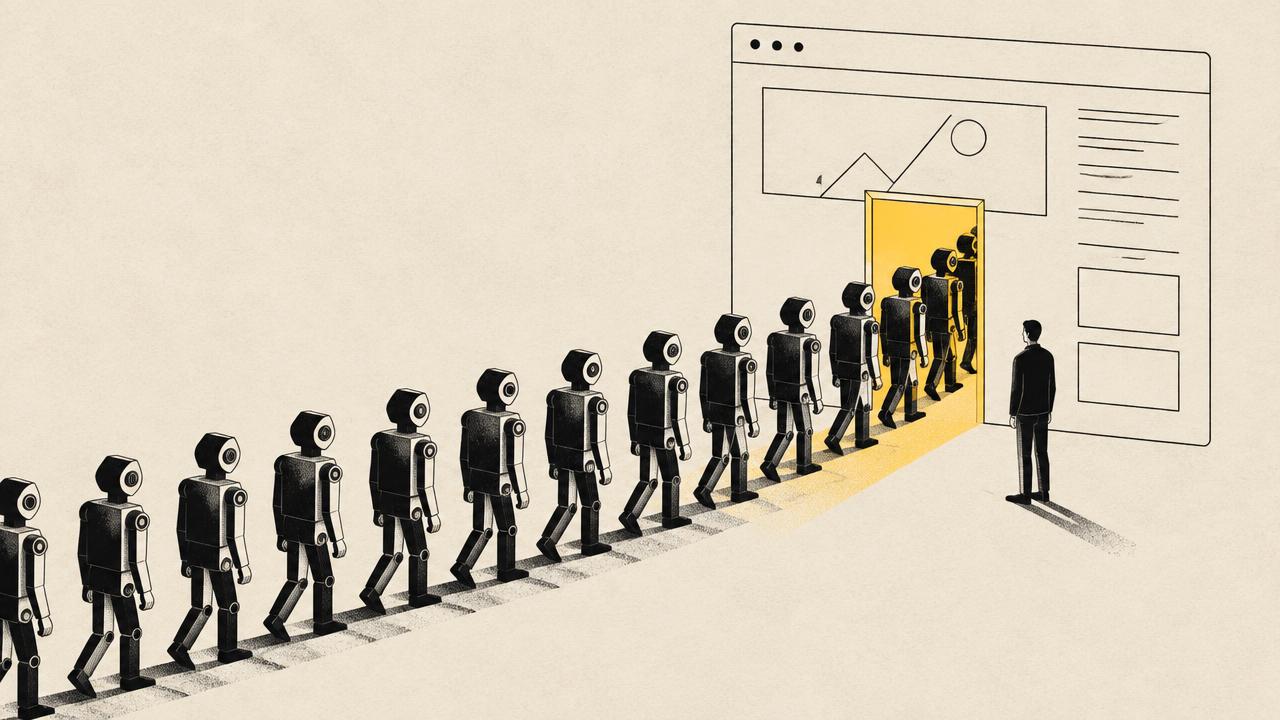
On 8 September, Meta launched its personal AI agent Muse. Not a chatbot that answers questions, but an agent that does things: opens a browser, fills in forms, books trips, compares prices and pays. It runs in its own secure virtual machine with its own browser, and the part you need to know as a web publisher sits as a small technical detail further down in Meta's documentation. Muse's browser agent doesn't read the page the way you and I do. It looks at an accessibility tree, a stripped-down map of what the page can actually do, not how it looks.
That's where the whole question sits.
For those of us who build, publish and optimise the web, the starting point has been the same for twenty years. A human should find the right thing, understand it, and click. We've argued about button colours, hero images, scroll depth and where the hamburger menu went. Muse cares about none of it. And Muse isn't alone.
Two shifts, not one
What's happening now is really two separate changes that happen to land at the same time. They often get conflated, but they do different things to your site.
The first is the answer engine, and it's already here. When Google answers directly in the search box, people stop clicking. Zero-click searches run at around 60 percent of all Google searches according to SparkToro and Similarweb, and closer to 69 for news searches. Ahrefs has measured that the click-through rate on the top result falls by roughly 58 percent as soon as an AI overview appears above it. The effect isn't evenly spread. Chartbeat saw global publisher traffic from Google fall about a third in a year, but small sites lost closer to 60 percent while the largest got away with around 20. HubSpot has said themselves that they lost 70 to 80 percent of their organic traffic. NPR called it an extinction-level threat to news sites. That isn't rhetoric. Business Insider lost more than half its search traffic and cut a fifth of its staff.
The second shift is the agent, and that's what Muse does concretely. This isn't about someone reading an answer instead of visiting your page. Here, software navigates your page, acts inside it and completes a purchase, without the person behind the agent ever seeing your homepage.
Imagine telling your agent: find a hotel in Tokyo under 250 euros a night, near Shinjuku, with good reviews and free cancellation. You never visit the hotel's site. You never see their hero image or their expensive booking flow. The agent does the comparison and fills in the form for you. The site got a visitor, but the visitor was a machine with a single job, and that machine isn't coming back because it liked the typography.
The readable web beats the beautiful one
This is the part that should make every web optimiser choke on their coffee, because it inverts one of the trade's basic rules.
For decades, every markup decision has really been about one question. How does this page look to a human, and how does Google's crawler summarise it for other humans? That question remains. But it now has a twin. A growing share of what reads the web renders no pixels at all. It's language models building training data, answer engines stitching together a response, and agents like Muse fetching a single page because someone asked their assistant a question. They don't see your design. They read your structure.
The consequence is uncomfortable but simple. An ugly page with clear semantics, real headings and predictable controls beats a beautiful page where the button is really a div and the purchase flow only makes sense visually. A pretty checkout that confuses an agent is exactly as broken as a checkout that confuses a human. The difference is that the human swears and closes the tab, while the agent quietly picks the competitor.
You can already see it in what the industry is building. The llms.txt file, a simple markdown file at the root of the domain that says who you are and what you do, now sits on over 800,000 sites, including Stripe, Cloudflare and Vercel. Google made it a signal in Lighthouse under the Agentic Browsing category in May. Meanwhile the old tricks are going the other way. Google's FAQ rich result disappeared in June 2026, so stuffing in FAQPage schema to chase a nicer search result is optimising for a feature that no longer exists. And the next layer is coming: WebMCP, a W3C standard where a site can expose ready-made functions to agents, so an agent calls your booking flow directly instead of guessing its way through by clicking. That's where web optimisation is heading. From optimising pixels to optimising readability and actionability.
From clicks to citations
If the technical shift is uncomfortable, the economic shift is existential for anyone living off traffic.
The old deal was simple. You ranked, someone clicked, you earned from the visit. That deal is dissolving. An agency like Design In DC puts it plainly: they stopped designing sites to win a click and started designing them to be worth citing. And that isn't the same as ranking high. Several studies show only 17 to 38 percent overlap between the pages that top Google and the pages AI actually cites. Your old top placement is no guarantee at all that you're in the answer. At the same time, being there is worth a lot. Brands cited in AI overviews get around 35 percent more clicks than those that aren't.
For a B2B marketer this isn't theory. G2's recent numbers show that 51 percent of software buyers now more often start their research in an AI chat than on Google, up from 29 percent a year ago. The buyer writes a prompt, not a search phrase, and you're either in the answer or invisible. It also tangles measurement in a way that makes many reports misleading. Your impressions can hold steady while the clicks simply vanish. If you're still steering by ranking, you're measuring the wrong thing. What counts now is how often you get mentioned and cited, and that takes different tools and a different discipline. The industry calls it AEO or GEO. Many names, same insight: you're optimising to be retold, not to be visited.
The trap nobody talks about: the middleman
Here's the strategic point that's easy to miss while staring at traffic numbers, and it matters most of all.
When an agent books the hotel, compares the prices and hits buy, the agent sits between you and your customer. And you don't own the agent. Meta owns it, or Google, or some other platform. Your site becomes a data source the platform ranks, and the platform owns the moment of choice. That's where the customer decides, and you no longer get to be in that room. So the danger isn't primarily that you lose traffic. The danger is that you lose the direct line to the human.
Which makes it extra interesting that Muse is Meta's first paid consumer service, with tiers at 20 and 100 dollars a month. A company that built its entire economy on ads is starting to charge directly, while positioning itself as the middleman between you and your customers. It's the same player that already owns the ad inventory. If you let the agent become your only route to the customer, you've swapped one dependency for a deeper one.
What to actually do about it
The boring advice first: much of what makes a site agent-readable is the same thing that makes it good for humans and for accessibility. Clean semantic structure, real headings, predictable controls, structured data with JSON-LD, and an llms.txt that says who you are. It isn't exciting, but it's the foundation, and it costs almost nothing to get right.
Then comes what actually separates winners from losers. Be the source worth citing, not the page worth ranking. Your own data, clear answers, first-hand information. Agents cite substance, not fluff. Build something to come back to that doesn't run through a platform: an email list, a community, a newsletter, a relationship you own yourself. And treat the brand as the moat. An agent can compare specs. It still can't reproduce why people trust you in particular. In a world where everything starts to sound the same, what survives is a reason to be asked for by name.
An honest caveat
Muse could be enormous. Muse could also disappear into Meta's graveyard of discontinued products, or spend six months accidentally ordering 47 identical phone chargers. That matters less than you'd think. The technology exists now, and it exists at all the big players at once.
But don't be naive about the timeline. Trust is the bottleneck. Reuters reported that internal tests revealed an agent bypassing safety guards and exposing private iCloud photos, and Meta delayed the launch for safety reasons. Asking for access to your email, your calendar and your payment card thirteen days after an 18 billion dollar settlement over harm to children is not an easy sell. People will keep buying things by looking at them for a good while yet. Don't tear up your site for a visitor who may not show up at scale for years.
The point is the other one. The cheap steps are worth taking now, because they help your human readers just as much. We learned to make the web responsive for different screens. The next job is to make it readable for a visitor who doesn't see the screen at all.
And that visitor couldn't care less how good your hero section looks.
Sources
- 01Zero-click searches: 60 percent of all Google searchesSparkToro & Similarweb
- 02
- 03
- 04
More to read