
The generalist was supposed to win. The opposite happened.
What you'll get
A sharper view of which skills gain value when AI makes breadth and execution cheap.
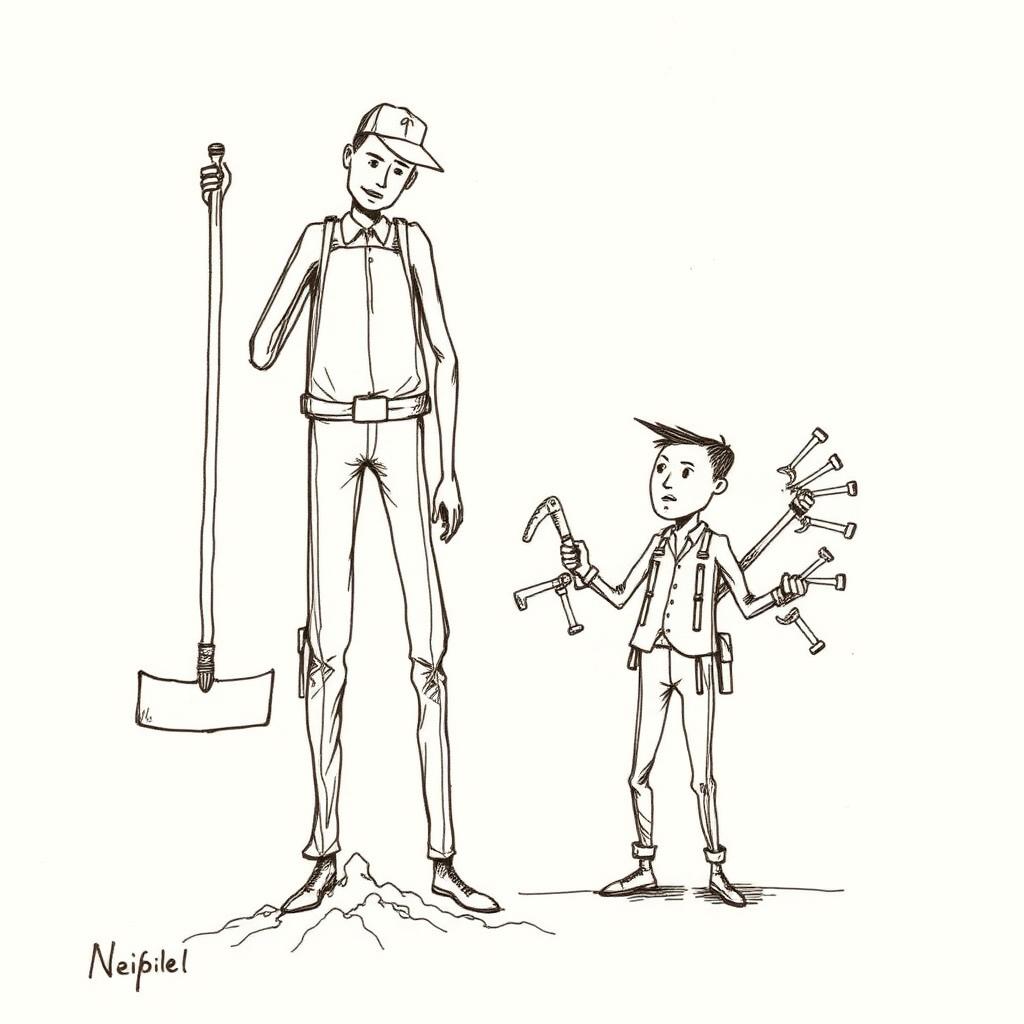
I've built my whole career on knowing a little about a lot. Music, production, marketing, communication. Never the best in the room at anything, but the one who could talk to everyone and put the pieces together. For ten years it's been a weakness I've had to explain away in job interviews.
Then 2023 came, and suddenly I was the one who was supposed to win.
The story was everywhere. AI democratises skill. Now the marketer can code, the designer can write, the writer can build an app over a weekend. The specialist is dead, because AI does the specialised work for you. What's left standing is the generalist, the one who sees the whole map and connects what no one else sees. David Epstein's Range got a second life. I read headlines like "The Rise of the Generalist" and felt seen for the first time in ages.
Nice feeling. It didn't last.
Because if you look at what actually happened, and not what people wrote on LinkedIn, everything points the other way.
The clearest sign is in the research. A model from economists Ide and Talamàs splits AI into two kinds of help. Copilots, which sit beside you and suggest, help the less skilled the most. They raise the floor. But agents, AI that works independently, mostly benefit the very best. They raise the ceiling. And in 2026, the whole industry is moving from copilot to agent. We're no longer building tools that help the beginner. We're building tools that make the expert dangerous.
The same thing shows up in salaries. PwC's data shows that AI specialists continue to command a clear pay premium. Depth pays off. Breadth has become free.
And that's the core of it. AI made execution itself cheap. Producing a text, an image, a campaign, a simple bit of code now costs almost nothing. So the value moves elsewhere, to judgement. To knowing what's good. And the person who knows exactly what good looks like in their domain is the specialist, not me.
A specialist with AI becomes ten times sharper. A generalist with AI becomes someone who produces mediocre things in ten areas, just faster.
I saw it in myself. Last year I built an outbound agent, hooked it up to a CRM, and it booked meetings and brought in paying customers in the first week. Classic generalist move, a marketer building software. But what made it work wasn't my breadth. It was the small piece of specialist knowledge I happened to have about outbound. The breadth, being able to cobble the tech together, was exactly the part AI gave me for free.
In marketing, the pattern became especially clear. The winners were the measurable specialists. Performance, paid, growth, SEO, CRO. Their job is exactly what AI is best at optimising, because it can be measured in real time, tested in a hundred variants, and dialled towards a number. So that's where the money went.
And there's a loser in that story. Brand.
Binet and Field have shown for decades that the optimal split for most brands is around 60 percent brand-building and 40 percent activation. WARC's 2024 figures showed reality had slid the exact opposite way. Almost 69 percent of budgets went to short-term performance, up from around 60 percent in just a year. Brand fell to 31 percent. AI poured petrol on a fire that was already burning.
This is where it gets uncomfortable. Because brand is the one thing AI can't fake. When feeds fill up with the same AI-generated content, the same angles, the same well-phrased nothingness, a brand with its own voice and its own memory in people's heads is the only thing that stands out. That's the moat. It should be worth more than ever.
We're investing in it less than ever.
So the generalist was supposed to win, and the specialist won. Breadth was supposed to become premium, and became free. Brand was supposed to be the last thing left worth anything, and became the first thing we cut.
I don't regret being a generalist. But I've stopped believing AI came to save me. It came to amplify whoever had already gone deep on something. The question I can't let go of is simple: if what you already have is breadth without a bottom, what exactly is AI supposed to amplify?
More to read