
Go-to-market strategies 2026: the examples that work – and what a GTM strategy really is
What you'll get
A clear definition of go-to-market strategy, five examples that work in 2026 and the research that explains why.
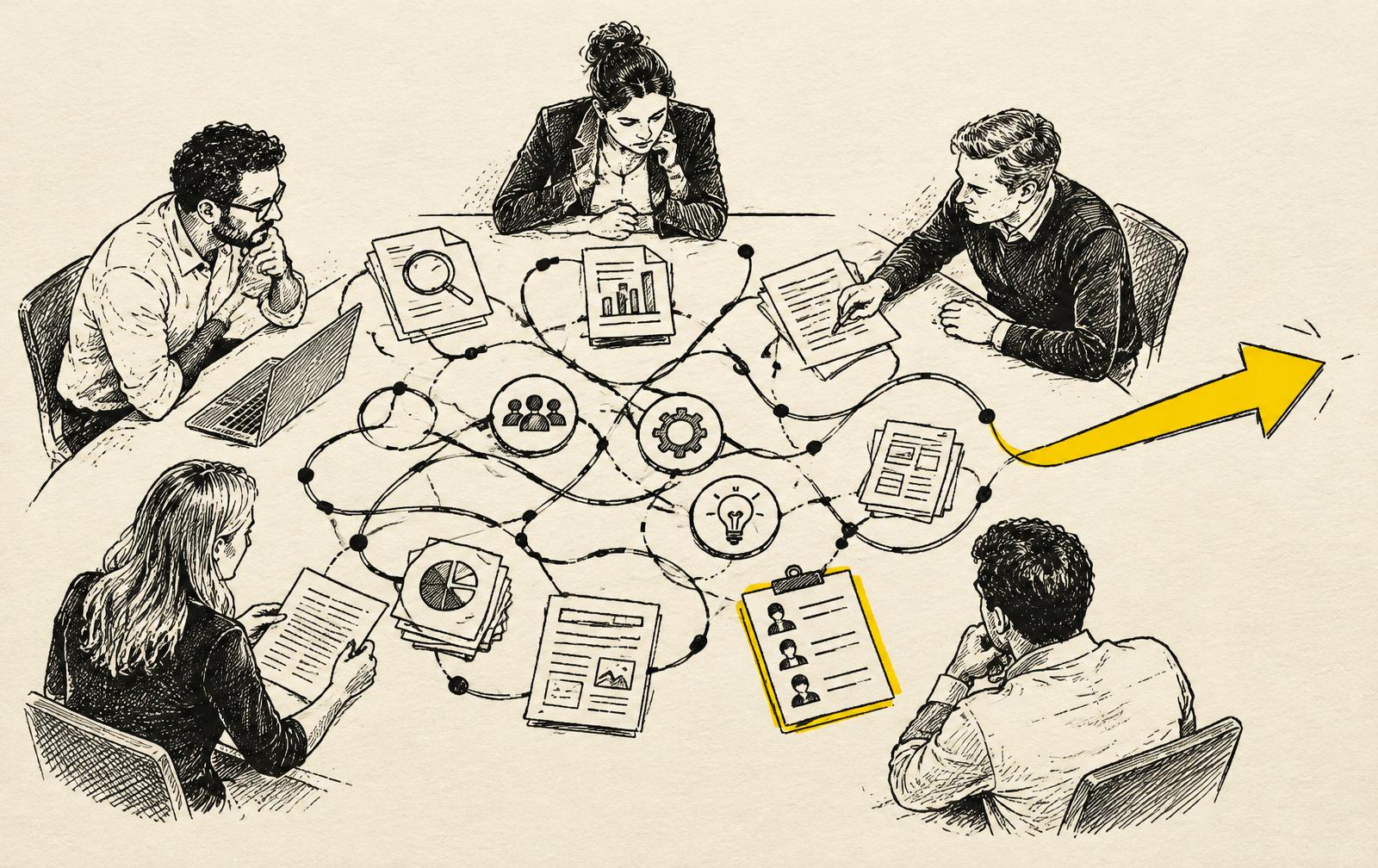
'Go to market' is one of the most used and least defined terms in marketing. Here is what a go-to-market strategy actually is, five examples from 2026 that I think show the way, and the research that explains why they work.
What is a go-to-market strategy?
A go-to-market (GTM) strategy is the plan for how an offer reaches its buyers, gets chosen and becomes easy to buy. It answers five questions.
A GTM strategy is five answers on one page.
- 01
Who
Which buying situations you prioritise
- 02
What
The problem you solve, and why you
- 03
Where
Where the buyer researches and chooses
- 04
How
The motion that carries growth
- 05
Who does what
Marketing, sales and product without visible seams
Explanatory model based on the article's definition. Not research data.
The classic answer has been a funnel that starts with reach and ends in a sales meeting. What has changed is where the buying decision is made. It shows most clearly in the companies that succeed.
Five go-to-market strategies that work in 2026
My picks and interpretations of public examples, not measured results. Five different motions with one thing in common.
Five motions. Chosen before sales arrives.
Figma
Product-led
Every shared file invites the next buyer
Clay
Category-led
Named the role, the GTM engineer
Gong
Research-led
Data sales leaders shared with each other
HubSpot
Education-led
Open material that AI answers draw on
Lovable
Community-led
Customers show what they built
Editorial comparison of the examples in this article. A qualitative interpretation of public examples, not a ranking or measured results.
Figma: the product as sales channel
Figma built its design tool in the browser from day one. It sounds like a technical detail, but it was a GTM decision: a link is all it takes for someone to open, comment and work in the same file. The designer invites a product manager, who invites a developer, who brings in a colleague from marketing. Every collaboration shows the tool to a new person, in a situation where they already need it.
When procurement finally gets involved, the organisation has often already chosen. The usage is there, the files are there, the habits are there. The seller's job becomes making the choice safe for IT and finance, not convincing anyone the tool is good.
Lesson: product-led growth is not the same as a free tier. It is building the product so usage is visible to the next buyer. Ask yourself: when a customer uses us, who else sees it?
Clay: create the role before selling the tool
Clay could have marketed itself as yet another prospecting data tool, a category crowded with competitors. Instead it named a new way of working: the GTM engineer, someone who builds sales processes with data and automation rather than manual lists. Around the role came templates, courses, job ads and a community where people share their workflows.
The effect is that Clay doesn't have to win a comparison against other tools. When someone wants to get better at the role, or a company hires for it, Clay is already part of the answer. The category and the brand become the same memory.
Lesson: if you own the word for the buying situation, buyers think of you when it arises. Ask yourself: is there a way of working or a role your best customers share that nobody has named?
Gong: research that earns the shortlist
Gong records and analyses sales calls. Early on it began publishing what the aggregated data showed: how much top sellers talk compared with the customer, when to bring up price, which questions move a deal forward. It was concrete, slightly surprising and easy to forward to colleagues.
Sales leaders shared the analyses on LinkedIn and internally long before they were looking for a tool. When the need arose, Gong was already linked to the question 'what separates good sales calls from bad ones?'. The content built the shortlist, not just traffic.
Lesson: content that helps buyers do their job better builds memory in the category. Ask yourself: which insight do only you have, because you hold the data or the experience?
HubSpot: education as availability
HubSpot is the textbook case of inbound. A free CRM, certifications in HubSpot Academy, templates and guides on everything from email to sales process. A new marketer learns the trade with HubSpot's material, often years before she has a budget to buy with.
The less noticed effect in 2026 is what that material does in AI search. When a buyer asks a chatbot how to build a lead process, the answer draws on open, well-structured and frequently cited sources. HubSpot has published those for more than a decade. It is physical availability in a new environment.
Lesson: what you publish openly today is the raw material for tomorrow's AI answers and shortlists. Ask yourself: if an AI explains your category, whose writing is it borrowing?
Lovable: building in public
Lovable, the tool this site is built with, sells something hard to explain in an ad: building an app by describing it. So it lets users explain it. People share what they built on X, LinkedIn and YouTube, and the team launches and talks about updates in public.
Every shared project is both proof and demo. A potential buyer sees not a supplier's promise but someone like her who has already succeeded. That lowers risk before anyone talks to a sales team, which suits a time when buyers trust other buyers more than suppliers.
Lesson: when buyers trust peers more than you, visible customer results are the strongest channel. Ask yourself: how easy is it for a happy customer to show what they achieved with you?
Why it works: the favourite is chosen before the first meeting
6sense followed almost 4,000 B2B buyers in 2025. In roughly 80 per cent of won deals the winner was already the favourite before first contact, and in 95 per cent the winner was on the day-one shortlist.
The visible journey starts after the preference is formed.
80%
Won by the pre-contact favourite
95%
Winner was on the day-one shortlist
On average, roughly 60% of the buying journey was complete before first seller contact.
Source: 6sense, B2B Buyer Experience Report 2025, almost 4,000 buyers globally. 6sense sells buyer-intelligence software; treat the findings as a large vendor study, not a universal law.
Sellers still matter, but more often enter to confirm and reduce risk than to create preference. 6sense sells intent data, so read the figures as direction, not law.
AI has moved into the research phase
Forrester reported in January 2026 that 94 per cent of business buyers use AI somewhere in the purchase. According to G2, 51 per cent of software buyers more often start in an AI chat than in Google.
AI is becoming a research layer, not merely a work tool.
94%
Use AI somewhere in the buying processForrester
71%
Use AI chatbots during researchG2
51%
Start more often in AI chat than GoogleG2
Sources: Forrester, January 2026 (AI use: 89% in 2024, 94% in 2025); G2 Answer Economy 2026 (1,000+ B2B software buyers). Different studies and samples; the bars should not be read as one time series.
It barely shows in traffic. Octane11 found AI search in under two per cent of referrals, but an AI touch in roughly one in eleven won deals. Few clicks, big influence. Attribution calls it direct traffic.
More outreach solves the wrong problem
When pipeline thins, most teams increase activity. Gartner shows why that backfires.
More contact is not the same as more relevance.
61%
Prefer a rep-free buying experience
73%
Avoid suppliers sending irrelevant outreach
Source: Gartner survey of 632 B2B buyers, conducted August–September 2024 and published 25 June 2025. The measures describe preferences and avoidance, not conversion rates.
A buying signal decides when you knock. Memory decides whether the door opens. If the recipient has never heard of you, the personalised email is still a stranger.
GTM needs two kinds of availability
Ehrenberg-Bass and the LinkedIn B2B Institute separate mental availability, being thought of in a buying situation, from physical availability, being easy to find and buy when it arises. Both start in the situation: 'our forecast can't be trusted', not 'we need a CRM'.
GTM connects the buying situation to the next easy step.
- 01
Buying situation
A change creates a need
- 02
Mental availability
The brand comes to mind
- 03
Physical availability
It is easy to find and evaluate
- 04
Sales
A person reduces risk and helps decide
Explanatory model based on Category Entry Points and mental/physical availability research from the Ehrenberg-Bass Institute and LinkedIn B2B Institute. This is a synthesis, not a measured funnel or conversion model.
How to build the strategy: four decisions
1. Map situations, not segments
Choose five to seven events that make a buyer start looking. Ask new customers what changed in the weeks before.
2. Audit the shortlist
Ask won and lost customers which suppliers they considered from the start. If you are missing there, demo conversion is not the problem.
3. Track AI answers
See which brands appear for your most important buyer questions and how you are described. Use it as market research, not ROI.
4. Give sales a continuation, not a restart
The first meeting should start where the buyer's research ended, not with company history.
The new GTM question
The job is not the most leads. It is being remembered in more buying situations and making the next step easy. The key GTM question in 2026 is not how you enter the CRM earlier, but how you enter the mind earlier.
Sources
- 01The B2B Buyer Experience Report 20256sense Research, november 2025
- 02B2B Buyers Make Zero-Click Buying Number OneForrester, 22 januari 2026
- 03
- 04State of B2B AI SearchOctane11, 2026
- 0561% of B2B buyers prefer a rep-free buying experienceGartner, 25 juni 2025
- 06Category Entry Points in a B2B WorldLinkedIn B2B Institute & Ehrenberg-Bass Institute
- 07FigmaExempel 1
- 08ClayExempel 2
- 09Gong LabsExempel 3
- 10HubSpot AcademyExempel 4
- 11LovableExempel 5
More to read