
Ritson vs Sharp
What you'll get
A practical way to decide whether you should invest in recognition or a stronger reason to choose you right now.
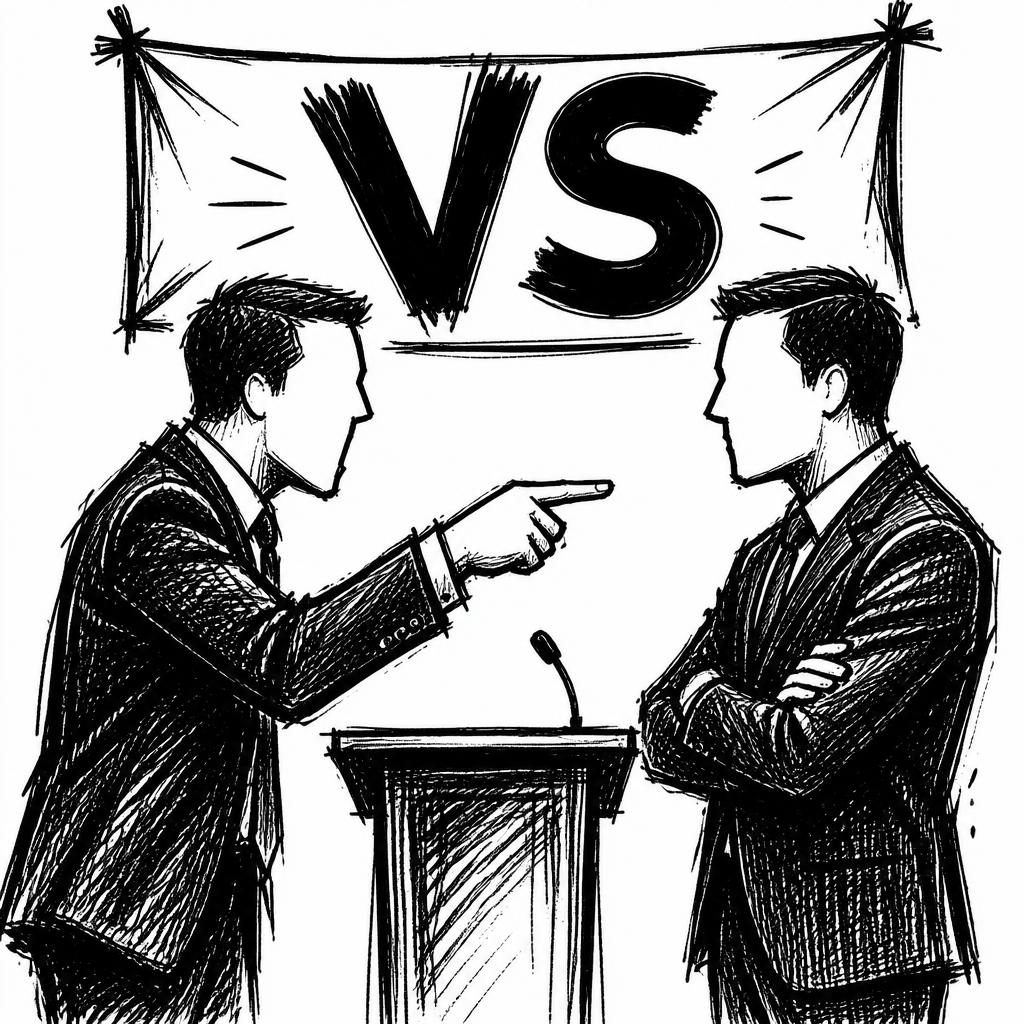
Let me take you to a room in Cannes last Monday.
Not the film festival. Cannes Lions, advertising's big festival, where the industry gathers for a week every summer to hand out awards and drink rosé.
On stage stand two men who almost never agree. Mark Ritson, the sharp-tongued professor behind the MiniMBA course. And Byron Sharp, the researcher behind How Brands Grow, one of the most widely read marketing books there is. They've been feuding for a decade. Now, suddenly, they're looking for common ground, under the title "Five Marketing Truths We Can Actually Agree On".
The room is packed. People are already calling it historic.
And they do actually agree on quite a lot. That the most important thing is being in the customer's head at the right moment, mental availability in the jargon. That brand purpose, meaning brands taking a stand on social issues, is overrated. That companies change campaigns far too often. Ritson even says that if your brand pops into someone's head right when they're about to buy, 70 to 80 percent of the job is already done. Sharp nods along.
But read the small print.
Because when they get to differentiation, the disagreement is deliberately smoothed over. "To honour the moment," as Andrew Tindall wrote in trade paper The Drum. Translated: they still don't agree. Ritson thinks differentiation, having a clear reason to be chosen, is achievable, though rare and worth guarding once you have it. Sharp gives the exact opposite verdict. Have it? Great. Lack it? Don't panic. It's completely normal. You'll manage anyway.
There's the whole debate for you. Delivered by the two people who own it. Unresolved when time ran out.
Keep that disagreement in mind. Because a few days later it turns up again, in disguise.
The carousel is the same ceasefire, drawn as a Venn diagram
This time it's a carousel in the feed. One of those slide series you swipe through on LinkedIn. Sender: MiniMBA, Ritson's own company.
It's bold for six slides and loses its nerve on the seventh.
First, six slides that contradict most of what you've learned. Consumers don't love your brand. Engagement, meaning likes and comments, means almost nothing. Being seen and recognised beats being liked. And Reddit, the forum many marketers long sneered at, has quietly become a place where people actually decide what to buy.
All true. All uncomfortable. All worth saying out loud.
Then, on the last slide: two overlapping circles, and the sentence "you need both".
That's where the marketing debate goes to die.
Because "you need both" is true in exactly the way "eat well and exercise" is true. No one disagrees. No one is helped. The difference from the Cannes stage is that there, at least, you got to see the seams. Here they've been sanded down into one cosy little figure.
The real question is never whether you need both. It's what you do when the budget only stretches to one. And there, without noticing, the carousel has already answered. It just picked the wrong example to prove its point.
First: what are we actually talking about?
Three words keep coming up. Here they are, without the academic clutter.
Distinctiveness is being seen and recognised. The colour, the logo, the sound. What Sharp calls looking like yourself. Think Coca-Cola's red, or the sound an iPhone makes on startup. You know who it is before you've had time to think.
Mental availability is being in someone's head at the right moment. Your brand popping up exactly when someone's hungry, thirsty or ready to buy.
Differentiation is having a reason to be chosen. Volvo and safety. Not about being seen, but about meaning something specific once someone actually compares.
A simple picture: distinctiveness gets you noticed in the crowd. Differentiation makes you worth choosing once someone's actually looking.
They sound alike. They aren't. They do different jobs, at different points in the purchase, for different money. That's why it's wrong to squeeze them into two equally sized circles with the magic in the middle.
Crypto.com proves the wrong thing
The carousel's star witness is Crypto.com.
You might remember them. The crypto exchange that, for a few years, sprayed money on advertising, bought a Matt Damon film for the Super Bowl, and put its name on the arena in Los Angeles where the Lakers play.
The carousel's point: everyone knew the name, few knew why it mattered. In other words, fame without a why is expensive decoration.
Nicely put.
Just wrong.
Because Crypto.com is still around in 2026. The arena, formerly called the Staples Center, they bought for 700 million dollars over twenty years. It's still the most expensive naming-rights deal in sports history, and the record stands. They've shut down some of their US operations, but the app is still around with over 80 million users, and the arena is still called Crypto.com Arena. That fame, which was supposed to be pure decoration, has survived an entire crypto crash.
If you want the example that actually proves the carousel's point, it's called FTX.
Same playbook. Same year. Another crypto exchange that bought an arena naming deal, this time in Miami, and chased the same kind of fame. Then: bankruptcy. The Heat basketball team cut ties immediately and renamed the arena after Kaseya, a rather dull software company that had one thing FTX lacked. A business that held together.
So fame didn't kill Crypto.com. The lack of a real business killed FTX. The difference wasn't how well positioned they were in the customer's head. It was whether there was anything underneath once the attention arrived.
That's a much more uncomfortable lesson than "have a why". And a much more useful one.
The answer was already in slide five
The funny thing is the carousel itself gives away the resolution three slides earlier. Without realising it.
Slide five is about WPP, the world's largest advertising group, and makes a sharp point: when you're forced to cut prices, that's usually a positioning problem. Winning customers by getting cheaper isn't growth. It's a slow slide downhill.
Put that next to the last slide, and the whole Venn diagram collapses.
Because now we have an order, not an overlap. Distinctiveness gets you into the game, makes you one of the names that comes up when someone's about to buy. Differentiation decides what happens next: whether you're chosen because you're cheapest, or because you're worth more.
One fills the pipeline. The other protects the margin.
The question neither the carousel nor Cannes answered
One of the slides was actually fresh news, not old theory in new packaging.
Slide three: Reddit has become a purchase engine, and AI search is amplifying that. It points at what all of Cannes 2026 revolved around this year, with its own AI category in the competition and AI as a running thread through the programme. And it points at the question neither the carousel nor the two men on stage got around to answering.
Sharp's big point is a shift in how you think. From "what does the brand make me feel?" to "what makes me think of the brand?" In other words: are you in someone's head at the right moment?
But more and more purchases no longer start in a head. They start in a prompt. Someone asks ChatGPT or an AI search engine: "which is best?"
And an AI has its own logic. Its own associations. Its own version of what pops up first, which isn't your customer's.
That's where it gets uncomfortable. Distinctiveness is built for the human eye that recognises a colour in half a second. An AI doesn't care about your particular shade of red. It cares about what's written about you, and where. Differentiation, meaning what's actually written down, the comparisons on Reddit, the reviews, the explanations, is exactly what the machine reads and picks up on.
Suddenly it might be differentiation, not distinctiveness, that decides whether you're even mentioned when someone asks an AI what to buy.
It's not a solution. It's a new fight. But whoever thinks "you need both" was the final word is missing that the balance between the two might be shifting. And that it's distribution, where and how you're found, that's shifting it.
For those of you without 700 million
Now for the practical bit. Because you probably don't run a crypto exchange, and you don't have an arena to rename.
For most companies, especially smaller ones and B2B companies selling to other businesses, the problem isn't that they lack a why. The problem is that they think they're differentiated, when in fact they're invisible. They've written three paragraphs about their unique method on a website nobody finds, and call it positioning.
For them, the whole point is distinctiveness. Get remembered at all, before you polish your why. In B2B it's especially true, since almost all potential customers aren't ready to buy right now. You build memories for years, so you're there the day someone actually starts looking. In a head, or in an AI.
But a small group does the opposite. They buy fame, fill the top of the funnel, become recognised, and then discover they can't charge for it. That's the Crypto.com risk, in miniature.
And here's the diagnosis, free of charge: if you're competing on price, it's not a visibility problem. It's a differentiation problem. Back to slide five.
Sharp is right for more people than you'd think, because most companies underinvest in being remembered. Ritson is right for those who already are, because that's when differentiation is what pays the wages. Visibility gets you on the list. Differentiation decides you're not the cheapest one on it.
Which camp you belong to depends on where you stand. Not on what's true in a textbook.
The seventh slide, again
The carousel was right to dare to be uncomfortable for six slides. Just as the two on stage in Cannes were right to look for common ground. The mistake wasn't what they said.
It was that the carousel lost its nerve right when it got interesting, and traded a sharp choice for a cosy diagram. Meanwhile the two people who actually own the question stood on a stage in France and admitted they still don't agree.
The brave version of the last slide draws no overlap. It asks a question: which of the two are you underinvesting in right now, do you know why, and does the answer hold even when it's a machine choosing on your customer's behalf?
Are you invisible? Stop polishing your why. Get remembered.
Are you remembered but cheap? Stop buying more visibility. Give people a reason to pay.
You need both. You already knew that. The question has always been which one you need more of right now. And that's the question no one wants to draw a diagram of.
More to read